Cantwell staff hears latest on water issues

Cantwell staff hears latest on water issues
LuAnn Morgan
Othello Outlook, June 09, 2009
PASCO – The Franklin County Commissioners hosted a forum for Sen. Maria Cantwell’s staff on Friday. The forum was set up to discuss the current water situation in the Columbia Basin and to introduce them to issues needing addressed.
David Reeloeg, Cantwell’s central Washington director; Paul Wolfe, Washington, D.C., legislative assistant for agriculture policy; and Joel Merkel, Washington, D.C., legislative assistant for water issues, heard from representatives of several water-related organizations in the Columbia Basin.
Problems highlighted included water shortages for crops, industry, cities and wildlife.
Bill Gray, of the Bureau of Reclamation, gave an overview of the Odessa subarea and explained the boundaries of the Columbia Basin Irrigation Project.
“The project is one million acres, with 670,000 developed,” Gray said. “House document 172 said it would take 75 years to develop in phases and this is just the next phase.”
Gray said there are two groups involved in the alternative study.
The objectives group uses the existing canals to add water to the system. This piece is now in the feasibility stage and includes widening and expanding the East Low Canal and building the East High.
“By doing these things, we can serve all the deep well lands in the subarea,” Gray said.
One of the two key parts of this group is the development of the Rocky Coulee storage reservoir. Water would be removed from the system in September, October and November and stored in that reservoir.
The other part is the Weber siphon complex. Gray said $50 million has already been appropriated and work is beginning to add 10,000 feet of siphon to allow 25,000 additional acre feet of water to the lower portion of the project.
Gray said the complex is scheduled to be completed Sept. 31, 2010.
The other group is developing a supplemental feed route, which is expected to be completed Dec. 31. All that is currently needed is to get the right-of-ways, Gray said.
Dennis Bly, Lincoln County commissioner said 10 percent of his area is dependent on deep wells, yet that same portion is credited with 40 percent of the value produced.
“I went to a meeting in 1975 where they talked about the wells dropping,” Bly said. “That was 30 years ago and still nothing has been done.”
Bly said he is in full support of anything that can be done to bring more canal water to the Odessa subarea and into the irrigation project.
“We have a lot of dry channels and lakes that could be made into surface storage,” he said. “Water is our lifeblood and we’re beginning to see a domestic well problem, too.”
Wells are drying up a mere one mile from Lake Roosevelt, he said.
Rick Miller, Franklin County commissioner, said the same thing is happening in Connell. Roger Bailey, who lives at the south end of the Odessa subarea, agreed with Miller.
“The more water we put out there, the better off we are,” Bailey said. “We’re in this together … from Wilbur to Connell.”
Paul Stoker, director of the Ground Water Management Area, said most cities aren’t aware of the water problems.
“Future evaluations of city water need to be done,” Stoker said.
Reeploeg said the meeting was a good opportunity for Cantwell’s staff to take information back to the Senator. He asked Stoker if it would help the situation to simply pull half the circles off-line.
“Most are already planting low-impact crops that use less water,” Stoker said. “Landowners are saying they aren’t going to invest the money to go deeper when their wells go dry.”
Stoker said the normal depth of wells in the 1940s was 700 to 900 feet.
“In the mid-80s, those wells began sucking air,” he said. “In the late ‘90s, farmers started going deeper.”
Today, some wells at 2,500 feet are not lasting for more than one irrigation season.
“This tells us we’re doing something wrong,” Stoker said.
Gray said help is on the way with the Weber complex.
“If all goes OK, the supplement to the East Irrigation District will be completed and they will be contracting with landowners,” Gray said.
Craig Simpson, manager of the East Columbia Irrigation District, said at that point, a voluntary application process for permits will begin.
“Weber will give us the opportunity to get where we want to go,” he said. “We will deliver 30,000 acre feet of water to 10,000 acres.”
Chris Voight, director of the Washington State Potato Commission, said the additional water is critical to the potato industry.
“This industry is complex and if it can’t get the supplies, it will shut down and go elsewhere, probably China,” Voight said. “We’ve already lost some production; this needs to be resolved shortly.”
Alice Parker, executive secretary of the Columbia Basin Development League, said the country’s economic situation is all the more reason to move forward on the project.
“We are in a recession the same as in the ‘30s,” she said. “The country spent $531 million to build the first half, but the return is $4 billion in raw product each year.”
Voight said additional concerns involve wildlife habitat, which is dependent on the project for survival.
Yet, environmentalists, Parker said, are saying no one can have any more water. However, the area will suffer a real environmental crisis if it doesn’t have the water, she said.
“We can’t afford to be a naysayer now,” Parker said. “We can’t afford not to do this.”
Copyright 2009 Othello Outlook
June 9, 2009
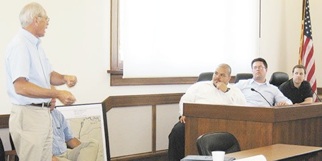
Bill Gray (left), of the Bureau of Reclamation, discusses water issues in the Columbia Basin with David Reeloeg, Paul Wolfe and Joe Merkel, staff members of Sen. Maria Cantwell’s Richland and Washington, D.C., offices.